Each week, CULTURALLY INCORRECT sits down with a different hyphenated American community for the conversation it has at home but rarely has on camera — dating, shame, marriage, faith — hosted by a writer, producer and journalist who has lived the questions he's asking.
More than 44 million immigrants live in the United States today, alongside tens of millions of their American-born children — Afghan-Americans, Arab-Americans, Iranian-Americans, African immigrants and their descendants, Latino Americans, South Asian Americans. Communities that carry two identities at once, in a country that alternately celebrates and questions their place in it.
CULTURALLY INCORRECT takes its title from the essential tension at its heart: the ways immigrant and diaspora communities are told — explicitly and implicitly — that their cultures, languages, and identities are somehow out of step with American norms. The show reclaims that friction as a site of inquiry rather than shame, treating every community as its own world rather than a single undifferentiated "immigrant experience."
Each 30-minute episode enters a specific community and a specific theme within it — an intimate, unscripted conversation intercut with a personal, direct-to-camera voice that opens and closes the hour.
The host frames the episode's central taboo, situates it in the community's history, and previews the panel — often citing outside research or a public thinker.
A moderated conversation with in-studio and remote experts, chosen specifically for that episode's community and topic rather than recurring across the series.
A short clip, quote, or cultural reference that grounds the conversation in lived, recognizable experience and gives the panel something concrete to react to.
A direct-to-camera essay from the host that synthesizes the conversation, resists easy answers, and gives the audience something to sit with after the episode ends.
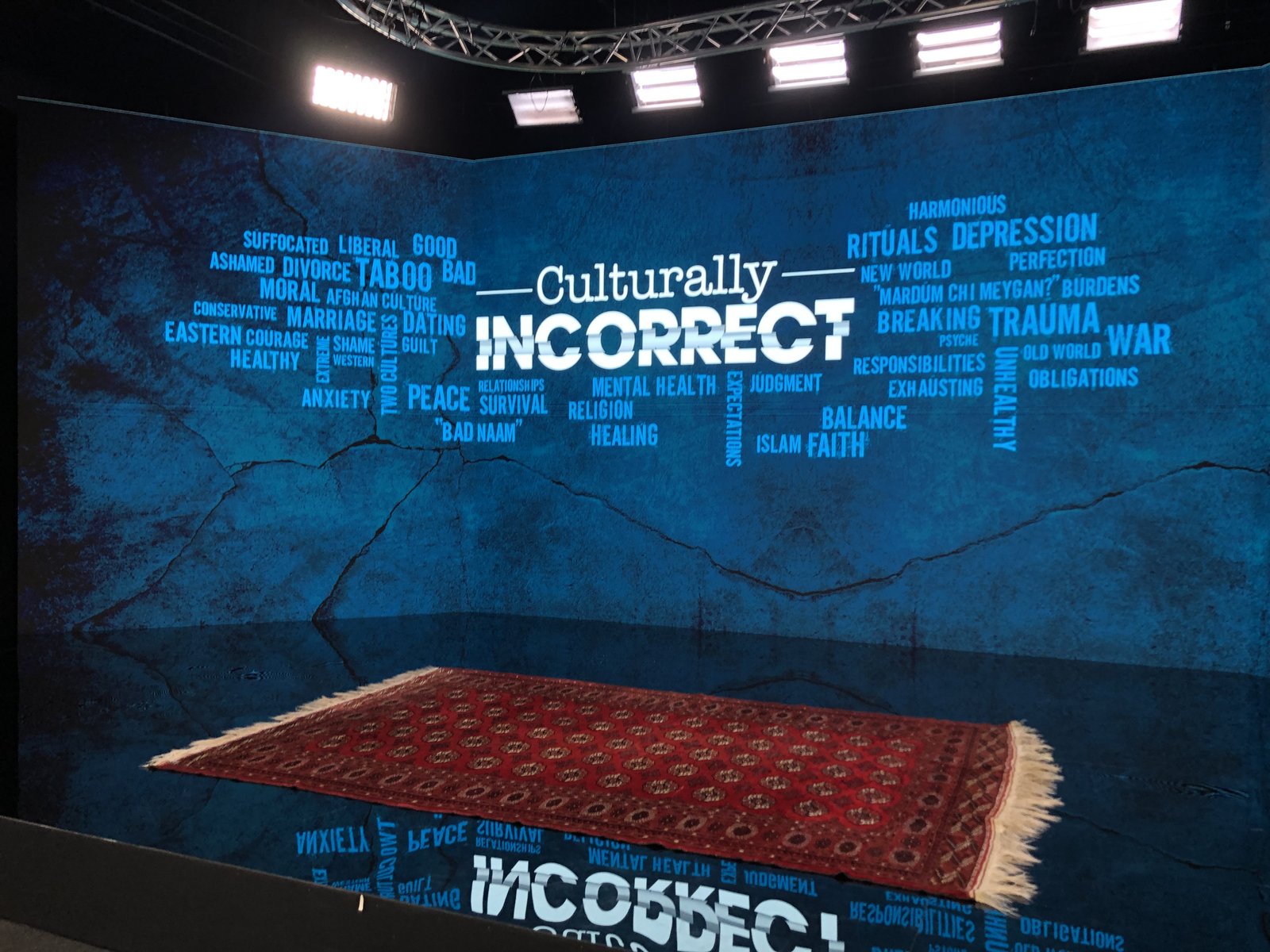
The pilot season — focused on the Afghan-American community — was produced independently and published on YouTube, with a panel of a clinical psychologist, a refugee-trauma specialist, and an Islamic studies scholar cast specifically for the season.
The panel debates whether "healthy Afghan dating" can exist at all — coining the term "Halal dating" live on air — while the host discloses her own divorce and a paused engagement in order to "consciously choose for myself."
Built around Brené Brown's distinction between guilt and shame, and the Dari/Farsi phrase "mardom chi meygan" — "what will people say" — the panel traces shame's power in a collectivist culture.
The cost and scale of wedding rituals, the gendered stigma of divorce, and the Islamic rules governing interfaith marriage — closing with a call for simpler rituals and wider premarital counseling.
Suleiman Wali brings to CULTURALLY INCORRECT insider credibility across the communities the show covers, combined with the professional discipline of more than two decades in American media — from network broadcast journalism to documentary filmmaking, from federal strategic communications to original IP development.
He is the host, writer, producer, and co-director of We, Too, Are America, a feature-length travel documentary produced by TriVision Studios that traces the historical ties between the Muslim world and Washington, D.C. — the on-camera hosting experience he now brings forward as host of this series. In addition, he wrote and directed The Trust: Brain & Body Assessment, a feature documentary following former NFL players — including Heisman-winner Ricky Williams — through the NFLPA-backed medical program examining what the game left behind, shot vérité inside Tulane Medical and Mass General.
CULTURALLY INCORRECT launches with a 40-episode first season. Three representative episodes below establish the range; future episodes explore African immigrant identity, Latino communities across the political spectrum, South Asian Americans, Arab and MENA Americans a quarter-century after 9/11, and cross-community conversations.
Not to debate the Middle East, but to talk about what it means to be a religious and ethnic minority in America right now — the shared experience of navigating identity in a country that often flattens both communities into political symbols.
Split for nearly five decades between those who mourned the Shah's fall and those who cheered it — an honest reckoning with Iran's past, America's role in it, and what Iranian-Americans share and cannot share.
Examining what today's political language does to the people it targets — the psychological toll, and the question of what recourse exists when the dehumanization comes from the highest levels of government.
TriVision Studios, headquartered in Chantilly, Virginia, is the DMV region's premier broadcast production facility, with nearly 30 years of experience serving television broadcasters, federal agencies, and Fortune 500 clients. In creative partnership with Lapis Media, Suleiman Wali's Washington, D.C.-area production company, the two form the same creative engine behind We, Too, Are America.
We welcome the opportunity to present a formal pitch, provide additional materials, or arrange a screening of the existing episodes.